Polymarket Copy Trading: How to Protect Your Strategy
Copy-trading tools are written for the copier. This is the other side of the trade — what to do when you're the wallet being followed.
On this page
How copy-trading works on PolymarketThe cost of being the copied walletWhy copy-trading is possible at allHow to protect your strategy — rankedThe honest boundaryFAQCopy-trading is usually written about from the copier's side: "follow the smart money." This is the other side of that trade — what happens when you're the wallet being followed, and how to keep the edge you worked for from becoming a public signal.
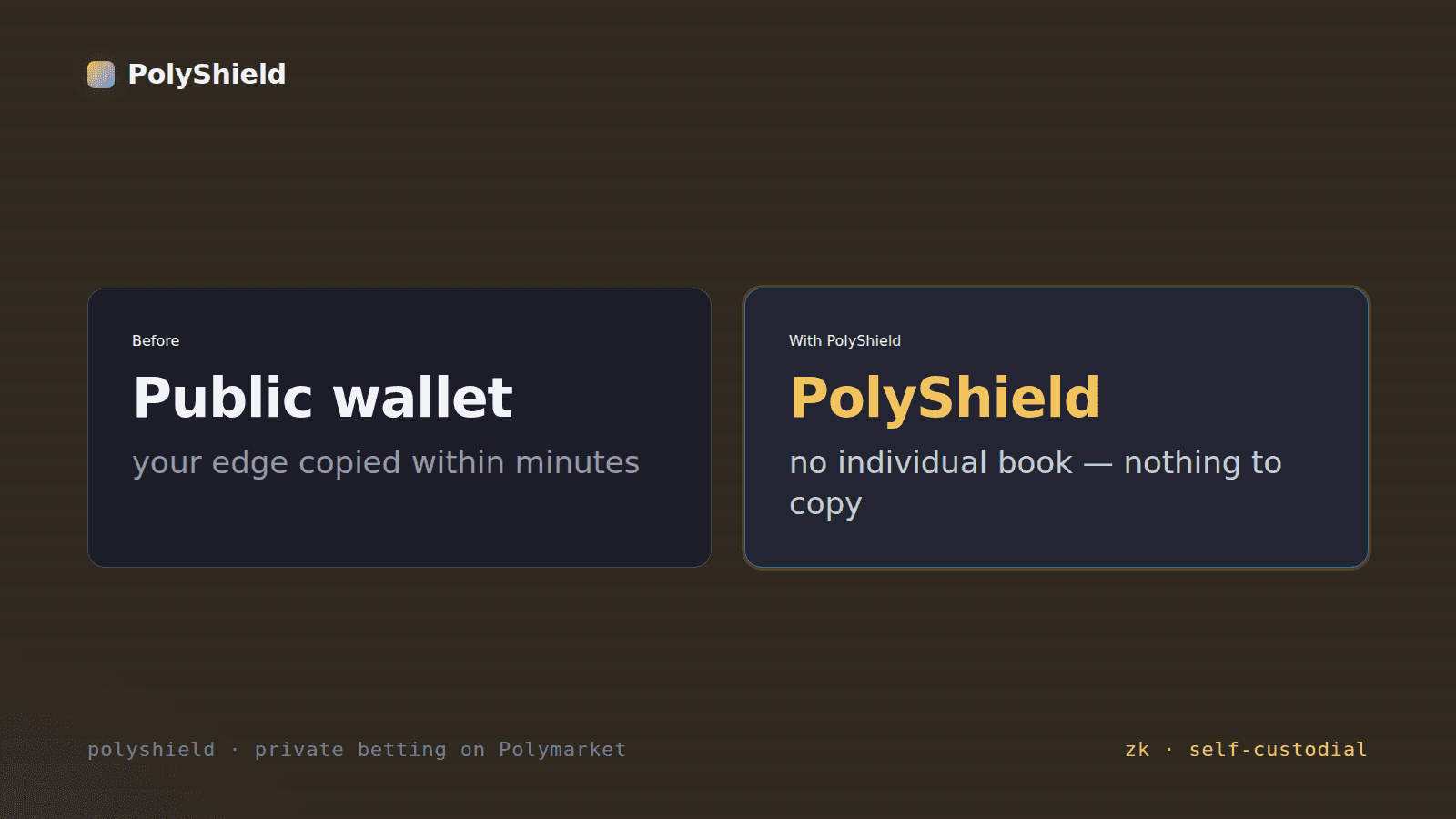
Yes — anyone can copy your Polymarket trades, because every position is public and tied to your wallet, and wallet-tracking tools mirror profitable wallets in near real time. To stop it, remove the public link between you and your bets with a zero-knowledge privacy vault: every bet is placed from one shared account, so there's no individual book to copy. Your deposit stays public by design; which bet was yours does not.
How copy-trading works on Polymarket
Because every Polymarket position is public and tied to a wallet, a whole category of tools indexes that data and surfaces "profitable wallets" to mirror in near real time. The mechanics are simple: a tool watches a set of addresses, and when one opens a position, it alerts followers (or trades automatically). No permission needed — the data is already public.
That's great if you're copying. It's a problem if you're the one with the edge.
The cost of being the copied wallet
When your positions are visible and someone's mirroring them, several things work against you at once:
- Your edge gets crowded. The whole value of an insight is that few people have it. Broadcasting your entries hands it to everyone watching, and the crowding pushes the price toward your view before you've finished building your position.
- Your fills get worse. As copiers pile into the same side, you pay up for the shares you haven't bought yet.
- You telegraph your moves. Exits are as visible as entries. People can see you de-risking and react before you're done.
- You become a target. A consistently profitable, visible wallet is a magnet — for copiers, for counter-traders, and for anyone who wants to trade against a known book.
The counterintuitive part
Much of the public commentary on Polymarket copy-trading concludes it doesn't work well for the copier — the alpha is in the timing, and by the time you see a trade, the price has already moved. That's true. But it doesn't help the person being copied: even unprofitable copying still crowds your book and degrades your fills. The leak hurts you whether or not it helps them. So "copy-trading doesn't work" is cold comfort if you're the one being copied — the damage is done at the moment your position becomes public, not at the moment someone profits from it.
Why copy-trading is possible at all
Strip away the tooling and the root cause is one thing: radical on-chain transparency. Polymarket settles on a public ledger, and every order is attributable to a wallet. Copy-trading, front-running, and whale-watching are all just downstream of the same fact — your activity is public by default.
So the durable defense isn't "trade sneakier." It's removing the public link between you and your trades.
How to protect your strategy — ranked
1. Throwaway wallets (weak). Rotating wallets adds friction and breaks down at funding and withdrawal time, where chain-analysis re-links them. Buys you a little noise, not real protection.
2. Manual obfuscation (fragile). Splitting positions, timing trades oddly, routing funds through hops — high-effort, easy to get wrong, and the positions are still public.
3. A zero-knowledge privacy vault (structural). This removes the signal at the source. With PolyShield, many depositors share one vault that holds one Polymarket account, and every bet is placed by that single account. On-chain, there's no per-depositor book to follow — which bet is yours is unlinkable, proven with zero-knowledge proofs. A copy-trading tool pointed at the vault sees one account doing a lot of things, with no way to attribute any of it to you.
That's the difference between hiding better and there being nothing to copy.
What you're actually protecting
Be clear about the claim: this protects your strategy privacy — the unlinkability of your bets from your wallet. It does not, and cannot, change your odds, your edge-as-in-expected-value, or your payouts. The point isn't that privacy makes you win; it's that publishing your book to the world makes winning harder, and you don't have to.
The honest boundary
A privacy vault doesn't hide that your wallet deposited, or how much — deposits are public on-chain by design. What it makes unlinkable is which bet a depositor authorized.
- That your wallet deposited, and the amount
- Every position the vault holds, its size and entry price
- Which depositor authorized which bet
- Your running strategy and exposure over time
- The deposit itself stays public — by design.
PolyShield is not a mixer, and you can only ever withdraw to your own depositing wallet. Your strategy stays private; your custody stays yours.
- Anonymity set
- The depositors whose bets are indistinguishable on-chain — bigger means more private.
- Withdraw-to-self
- Funds can only return to the depositing wallet — what makes this a vault, not a mixer.
→ Related: How to hide your Polymarket positions · How to bet on Polymarket privately.
Trade privately on Polymarket
Non-custodial, on Polygon. Your wallet never appears on a trade.
FAQ
Can people copy my Polymarket trades?
Yes. Your positions are public and tied to your wallet, so anyone can mirror them. Wallet-tracking tools exist specifically to do this.
How do I stop people from copy-trading me on Polymarket?
Remove the public link between you and your bets. A zero-knowledge privacy vault places every bet from one shared account, so there's no individual book to copy. Your deposit stays public; your bets don't.
Does using a new wallet stop copy-traders?
Only briefly. Funding and withdrawals re-link new wallets to your existing ones, so your positions can be reconnected.
Will my deposit stay hidden too?
No. Deposits into the vault are public by design, including the amount. The privacy is specifically about which bet was yours.