How to Hide Your Polymarket Positions From Trackers
Your position history is a public dataset. Here's what trackers read, why the usual fixes fail, and how to keep your active book private.
On this page
Yes — your position history is publicWho's reading your book, and why it costs youWhy the usual fixes don't hide positionsHide positions at the protocol levelThe honest boundaryFAQIf you trade size on Polymarket, your positions aren't just yours — they're a public dataset. Wallet-tracking tools exist for exactly one reason: your full position history is sitting on-chain, readable by anyone, in real time. This guide covers what's exposed, why the usual fixes don't hide positions, and how to keep your active book private.
Your Polymarket positions are public — open size, entry price, timing, and full history are all on-chain and tied to your wallet, which is exactly what whale-trackers read. To hide them, remove the wallet-to-bet link at the protocol level with a shared zero-knowledge vault, so every position is held under one account and none is attributable to you. Your deposit stays public by design.
Yes — your position history is public
On Polymarket, every position is recorded on Polygon and tied to the wallet that opened it. Pull up any address and you can read:
- which markets it's in, and which side (YES/NO);
- the size of each position;
- the entry price and the timestamp of every buy and sell;
- the complete lifetime history of that wallet.
A "whale tracker" isn't doing anything clever — it's just indexing public data and putting a nice UI on it. The exposure is the default state of trading directly. (For the full inventory of what leaks, see Are Polymarket trades public?)
Who's reading your book, and why it costs you
Three groups benefit when your positions are visible, all at your expense:
- Copy-traders mirror your entries. If you found an edge, they get it for free — and the crowding moves the price against you.
- Counter-traders see a large directional position and trade against it deliberately.
- Front-runners watch your order flow and get ahead of your next move, worsening your fills.
The common thread: the information is the leak. A position nobody can see can't be copied, faded, or front-run.
Why "trade smaller / trade quieter" doesn't save you
The intuitive response is to make yourself less conspicuous — smaller clips, odd hours, spreading a position across entries. It doesn't work, because every one of those clips is still a public position tied to your wallet. Splitting a 50k position into ten 5k buys just produces ten visible buys from the same address, and chain-analysis stitches them back together. You can't out-quiet a ledger that records everything.
Why the usual fixes don't hide positions
New wallet per position. It hides nothing once you fund it (the funding tx links it) or once you withdraw winnings to a known address. And managing a maze of wallets is its own operational risk.
A VPN or a "burner" email. These touch your network identity, not your on-chain footprint. The position is still public on Polygon.
Manual obfuscation. Timing tricks, hops, and splits are high-effort and fragile — and they leave the position itself attached to a public address.
Every one of these leaves the position attached to a public wallet. To actually hide the position, the bet has to be placed by something other than your wallet.
Hide positions at the protocol level
That's what a zero-knowledge privacy vault does. With PolyShield:
- many depositors share one vault, and the vault holds one Polymarket account;
- every bet is placed by that single shared account;
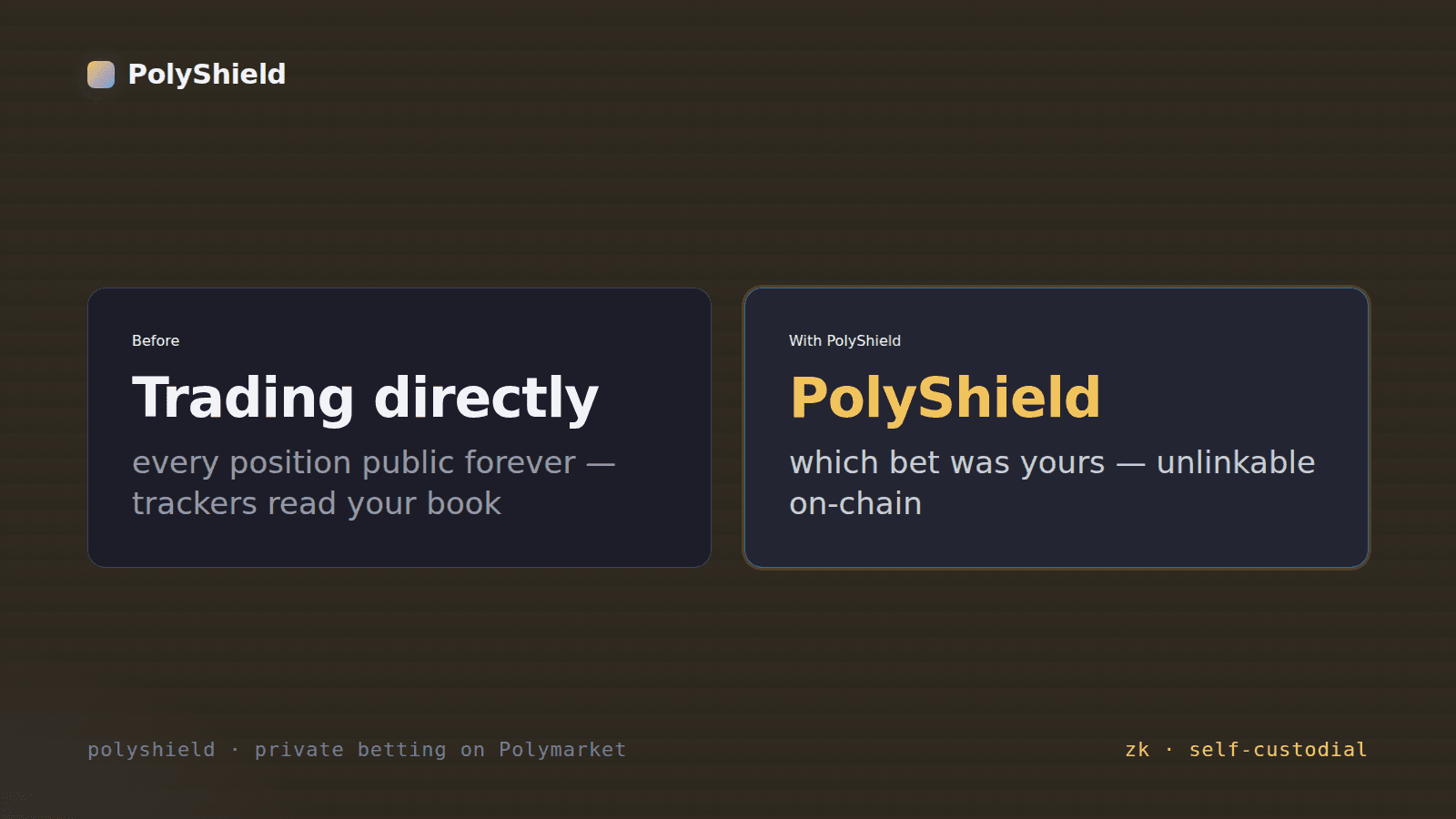
- on-chain, the positions all belong to the vault, and which depositor is behind any given position is unlinkable — enforced by zero-knowledge proofs, not by trust.
A tracker pointed at the vault sees one busy account, not your book. There's no per-depositor position to copy, fade, or front-run, because the link from a position back to a depositor isn't on the chain.
Before vs. after
| Trading directly | Via a privacy vault | |
|---|---|---|
| Your positions visible per wallet | Yes | No — held by the shared account |
| Size and entry price readable | Yes | Not linkable to you |
| Copy-traders can mirror you | Yes | No individual book to mirror |
| Your deposit visible | Yes | Yes (public by design) |
The honest boundary
A privacy vault does not hide that your wallet deposited, or how much — a deposit is an ordinary on-chain USDC transfer, and it's public on purpose. What becomes unlinkable is which position is yours.
- That your wallet deposited, and the amount
- Every position the vault holds, its size and entry price
- Which depositor authorized which position
- Your running strategy and exposure over time
- The deposit itself stays public — by design.
PolyShield is not a mixer, and withdrawals only ever return to your own depositing wallet. Stating that limit plainly is the point: privacy you can verify beats privacy you're asked to take on faith.
- Anonymity set
- The depositors whose positions are indistinguishable on-chain — bigger means more private.
- Withdraw-to-self
- Funds can only return to the depositing wallet — what makes this a vault, not a mixer.
→ See the full flow: How to bet on Polymarket privately · or the full inventory of what leaks in Are Polymarket trades public?.
Trade privately on Polymarket
Non-custodial, on Polygon. Your wallet never appears on a trade.
FAQ
Are my Polymarket positions visible to others?
Yes. Position, side, size, entry price, and timing are public on-chain per wallet, which is exactly what wallet-tracking tools display.
How do I hide my Polymarket positions?
Route bets through a zero-knowledge privacy vault so they're placed by one shared account. Individual positions can't be linked back to your wallet on-chain. Your deposit remains public.
Will a new wallet hide my positions?
Not reliably. Funding and withdrawals link a new wallet to your existing ones, so chain-analysis can reconnect the positions.
Does hiding positions also hide my deposit?
No. A deposit into the vault is public by design, including the amount. What's hidden is which bet or position a depositor authorized.